City Planning Commission Brownfield Program (CPCBP)
What is a Brownfield?
The Environmental Protection Agency (EPA) defines a brownfield as property, the expansion, redevelopment, or reuse of which may be complicated by the presence or potential presence of a hazardous substance, pollutant, or contaminant.
The CPC Brownfield Program is tasked with supporting project redevelopment and environmental clean-up. We have a defined target area and focus on projects that will positively benefit the City of New Orleans. Some of these sites may be smaller, such as former gas stations/dry cleaners, etc. Other sites are larger, legacy projects that will create needed community change and once revitalized, bring needed amenities. Many projects are stalled or do not move forward due to the high cost of proper remediation of contaminants. This is especially true with abandoned and/or damaged historic structures with a high price tag for renovation. Following the EPA guidelines for clean-up and reuse are essential to ensure the contamination does not affect the quality of life of residents. Brownfield funding help to bridge the financial gap when expensive contamination/assessment and clean-up are needed.
Questions?
Reach out with your questions to Kari Godchaux, Brownfield Program Director, City Planning Commission, kari.godchaux@nola.gov.
Brownfield Program News
City of New Orleans Awarded $2 Million by EPA for Remediation of Former Naval Support Activity Complex
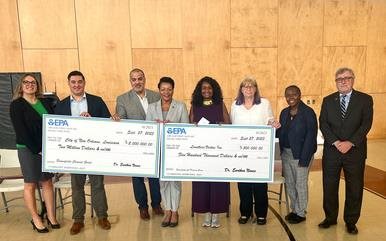 NEW ORLEANS — Mayor LaToya Cantrell today was joined by City Planning Commission (CPC) Executive Director Robert Rivers, CPC Brownfields Director Kari Godchaux, Environmental Protection Agency (EPA) Region 6 Brownfields Section Chief Althea Foster, Louisiana Department of Environmental Quality (DEQ) Secretary Roger Gingles and Limitless Vistas Executive Director Sherry Callaway to announce and present an award of $2 million from EPA to support the environmental remediation of the former Naval Support Activity Complex (NSA) located in the Bywater neighborhood. The award was from the EPA’s Brownfields Cleanup Grant program, funded by the 2021 Infrastructure Investment and Jobs Act (IIJA), also known as the Bipartisan Infrastructure Law.
“As the City of New Orleans remains on the frontlines of the ongoing global climate crisis, a top priority has been bolstering our more vulnerable, marginalized populations that have been disproportionally impacted by environmental injustices for generations,” said Mayor LaToya Cantrell. “We are honored to be selected as a recipient of EPA's Brownfields Cleanup Grant Program, which is a critical next step towards the renovation of this immense and derelict property. Once complete, this site will provide a resilient and sustainable source of power, as well as much needed affordable housing, commerce and job creation. My administration will continue to demonstrate our commitment to resolving our decades-long environmental issues and identifying sustainable solutions that are a win-win for our city and our residents and also in direct alignment with our federal infrastructure and climate action goals.”
The Brownfields Cleanup Grant program provides funding to carry out cleanup activities at brownfield sites to allow for future development. Funds are used to address sites contaminated by petroleum, hazardous substances, pollutants or contaminants, including hazardous substances co-mingled with petroleum.
The former NSA complex was completed in 1919 by the United States Navy and was used as a logistic station to protect the Port of New Orleans from attack, a shelter and training center for the unemployed and homeless during the Great Depression and later as a recruiting and training station for multiple military branches. It was deactivated and sold to the City of New Orleans in 2011 to facilitate its redevelopment. The complex is currently vacant and primarily consists of three 84,000 square-foot, 6-story buildings within an approximately 1.5 million square-foot site. All three buildings are listed under criteria A on the National Register of Historic Places due to its military history.
"The City Planning Commission is thrilled to have played a role in securing this funding for such a critical redevelopment project," said Rivers. "Since 2018, the CPC – led by its full-time Brownfields Director, Kari Godchaux – has been working with the Administration, as well as our regional, state and federal partners, to build a robust Brownfields Program for the City. This grant award is evidence of that work and demonstrates the value of the City’s continuing support of this important program."
“The City of New Orleans and the Limitless Vistas job training program have proved, again and again, the transformative power that EPA Brownfields grants can have for communities,” said EPA Regional Administrator Dr. Earthea Nance. “With historic amounts of funding available from the Biden-Harris Administration’s Bipartisan Infrastructure Law, these outstanding partners will continue to create benefits for local families and neighborhoods.”
EPA has also selected local nonprofit organization, Limitless Vistas, for a Brownfields Job Training grant. Limitless Vistas plans to train 200 students and place at least 120 in environmental jobs. Students who complete the training will earn up to three federal certifications. Limitless Vistas is targeting students from New Orleans, specifically dislocated, unemployed, underemployed and low-income individuals, minorities, opportunity youth, citizens with justice-system involvement and veterans. Key partners include the New Orleans Regional Planning Commission, the Sewerage and Water Board of New Orleans, Louisiana DEQ and the Urban League of Louisiana.
"The Brownfields program is our primary tool to get longstanding impaired properties remediated and rehabilitated," said Secretary Gingles. "It lets us give new purposes to neglected assets."
The City’s application for the Brownfields Cleanup Grant Program was submitted by the CPC’s Brownfields Program, in coordination with Mayor Cantrell’s IIJA Task Force. The City created the multi-departmental IIJA Task Force in January 2022 to analyze infrastructure needs within the City and secure funding from the new infrastructure law.
More information on the EPA Brownfields programs and awards can be found here: Multipurpose, Assessment, RLF, and Cleanup (MARC) Grant Application Resources | US EPA.
City Planning Commission Brownfield Program (CPCBP), among other Louisiana Brownfield Professionals, attend the National Brownfield Conference
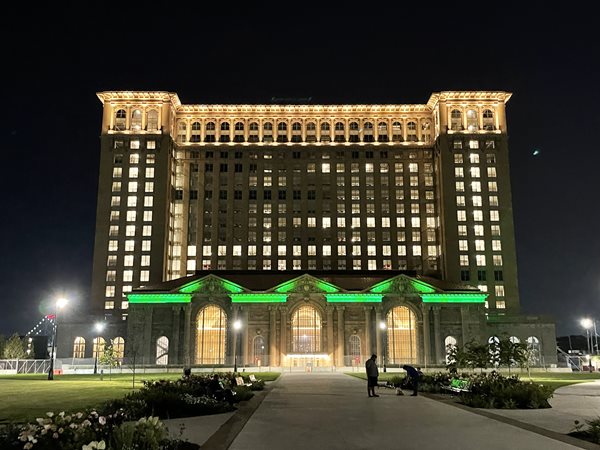 Detroit, Michigan hosted the National Brownfield Conference this year. It was a close look into the changes and successes Detroit is currently celebrating, using brownfield remediation as a catalyst, after declining and struggling as a city for decades. It was beneficial for CPCBP to learn from and collaborate with hundreds of Brownfield professionals from all over the nation, committed to the clean-up of harmful contaminants in soils, protecting residents, spurring investment, and bringing property/ historic buildings back into commerce. In addition, Kari Godchaux, City Planning Commission Brownfield Program Director along with fellow brownfield professionals were able to attend a site visit of a historic restoration legacy project, Michigan Central Station, formerly a highly contaminated brownfield. After being abandoned and neglected for thirty years, this significant historic structure is about to open its doors, once again, to the public. Ford Motor Company’s renovation costs totaled over $1B; a fine example of how brownfield funding and historic tax credits can spur large development projects and change neighborhoods.
Detroit and New Orleans share many parallels; history/loss of population/background of contaminated soils/ rebuilding/remediating/preservation and bringing land and formerly abandoned buildings back into commerce. The conference acted as a catalyst to discuss nationwide brownfield to greenfield successes and look to the future towards remediating brownfields to brightfields (remediating contaminated land to solar and other alternative energy uses). We also congratulated Phoenix Award winners like Louisiana’s own Rebecca Otte, LDEQ Brownfield Coordinator and winner of 2023 National Phoenix Awards for excellence in the profession, congratulations Rebecca!
City Planning Commission Brownfield Program Awarded $2 Million EPA Grant for Remediation of Former Naval Support Activity Complex
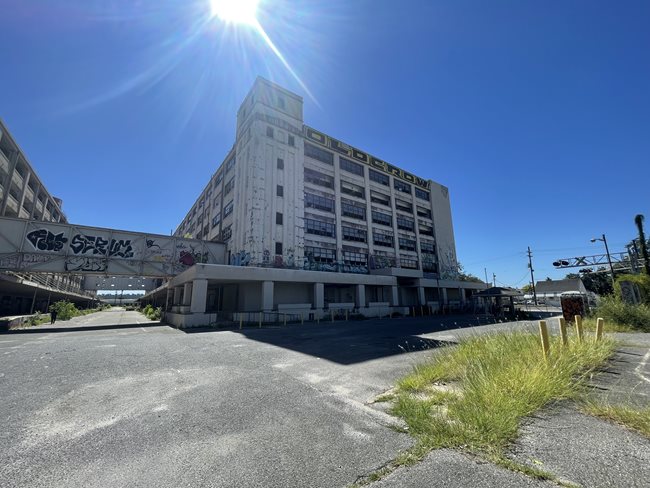 The EPA’s Brownfields Cleanup Grant program has granted an award of $2 million to the New Orleans City Planning Commission Brownfield Program to support the environmental remediation of the former Naval Support Activity Complex (NSA) located in the Bywater neighborhood. The award is funded by the 2021 Infrastructure Investment and Jobs Act (IIJA), also known as the Bipartisan Infrastructure Law.
Mayor LaToya Cantrell said, “The City of New Orleans is honored to be selected by the Environmental Protection Agency (EPA) to receive a $2 million Brownfield Clean Up Grant, applied for in November 2022 by the City Planning Commission’s Brownfield Program. This grant will support the environmental remediation of the former Naval Support Activity Complex (NSA) located in Bywater and is a critical next step towards the renovation of the immense, vacant, and derelict property. With this grant we are one step closer to the transformation of this long vacant Brownfield site, which when renovated, will provide much needed affordable housing and local job creation.”
The EPA Brownfield Clean-up Grant program provides funding to carry out remediation activities at brownfield sites to promote future development. Funds are used to address sites contaminated by hazardous substances, environmental pollutants, and/or contaminants. More information on the EPA Brownfields programs and awards can be found here: Multipurpose, Assessment, RLF, and Cleanup (MARC) Grant Application Resources | US EPA .
The former NSA complex, completed in 1919, was used initially to protect the Port of New Orleans from attack, later as a shelter and training center during the Great Depression, and finally as a recruiting and training station for multiple military branches. It was deactivated and sold to the City of New Orleans in 2011 to facilitate its redevelopment. The complex is currently vacant and primarily consists of three 84,000 square-foot, 6-story buildings within an approximately 1.5 million square-foot site. All three buildings are listed under Criteria A on the National Register of Historic Places.
CPC Brownfield Program & Tulane Master of Sustainable Real Estate Program Coordination
CPC’s Brownfield Program Director, Kari Godchaux, was invited to be a panelist for the Tulane’s School of Architecture Master of Sustainable Real Estate Program’s directed research presentations. Kari’s role for the directed research project was as a mentor, supervisor and coordinator for CPCBP intern Mario Das who spent two concurrent semesters at CPC Brownfield Program. This collaborative research project further represents City of New Orleans Planning Commission’s dedication to environmental research and project implementation pushing towards a cleaner, safer built environment in New Orleans. The directed research presentation titled: Brownfields to Brightfields; Revitalizing Brownfields with Solar Infrastructure in New Orleans highlighted the main points of the expanded in-depth research paper, showing the positive environmental and social benefits of remediating contaminated lands to solar energy production in New Orleans. The paper will be available to view at the City Planning Commission by July 1, 2023.
First Regional Brownfield Coffee Klatch
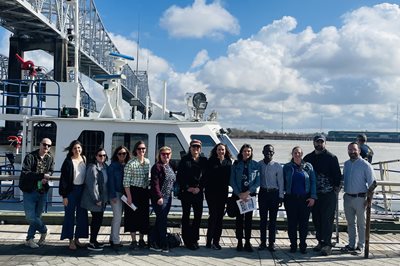 The first successful Brownfield Klatch meeting was hosted at the Port of New Orleans on January 11, 2023, and included members from the Port, State LDEQ, Regional Planning Commission Brownfield Program, Louisiana Department of Agriculture, City of New Orleans; City Planning Commission Brownfield Program, Jefferson Parish Economic Development Commission and Gretna Brownfield Program.
This successful event concentrated on communication and the importance of coordination between Louisiana governmental entities to support priority remediation projects for the benefit of the environmental health and rejuvenation of Louisiana. These meetings will be ongoing quarterly.
Draft Analysis of Brownfields Cleanup Alternatives and Public Hearing
The City Planning Commission held a public hearing on Tuesday, November 15, 2022 at 1:30 P.M. in the 21st Floor Conference Room of Orleans Tower, 1340 Poydras St., New Orleans, LA 70112 on the draft Environmental Protection Agency Cleanup Grant and Analysis of Brownfields Cleanup Alternatives.
| 2023 Draft Environmental Protection Agency Cleanup Grant – To consider the draft EPA Cleanup Grant application involving properties located in the Bywater, Holy Cross, St. Claude, and Lower Ninth Ward neighborhoods. |
Draft EPA Cleanup Grant is available for viewing at the CPC office. Please contact Kari Godchaux for more information. |
| Analysis of Brownfields Cleanup Alternatives – To consider the draft Analysis of Brownfields Cleanup Alternatives (ABCA) involving properties located in the Bywater, Holy Cross, St. Claude, and Lower Ninth Ward neighborhoods. |
Click here for Draft ABCA |
In addition to comments received at the public hearing, the City Planning Commission is accepting written public comments to the Executive Director by mail (1300 Perdido St, 7th Floor, New Orleans LA 70112) or by email at CPCINFO@NOLA.GOV.
Frequently Asked Questions
What is a Brownfield?
The Environmental Protection Agency (EPA) defines a brownfield as property, the expansion, redevelopment, or reuse of which may be complicated by the presence or potential presence of a hazardous substance, pollutant, or contaminant.
What does this mean?
This defines an area, vacant land or structure(s) that potentially contain contamination. This could include Arsenic, Petroleum, Cadmium, Chromium, Dioxin, Mercury, Pesticides Asbestos, PCB’s, Lead and other substances that could be harmful for humans and the natural environment. The full list is located at https://www.epa.gov/brownfields/common-types-brownfields-and-their-contaminants. These substances, often very expensive to clean correctly, can stall and/or prevent project development and reinvestment. It is estimated there are over 450,000 Brownfields in the United States. Bringing these properties back to commerce provides many positive impacts on communities and the environment.
What is land revitalization?
A process of assessing a property for contamination, cleaning up the property and returning the property to commerce.
How will the CPC Brownfield Program benefit New Orleans?
The CPC Brownfield Program is tasked with supporting project redevelopment and environmental clean-up. We have a defined target area and focus on projects that will positively benefit the City of New Orleans. Some of these sites may be smaller, such as former gas stations/dry cleaners, etc. Other sites are larger, legacy projects that will create needed community change and once revitalized, bring needed amenities. Many projects are stalled or do not move forward due to the high cost of proper remediation of contaminants. This is especially true with abandoned and/or damaged historic structures with a high price tag for renovation. Following the EPA guidelines for clean-up and reuse are essential to ensure the contamination does not affect the quality of life of residents. Brownfield funding help to bridge the financial gap when expensive contamination/assessment and clean-up are needed.
What are the economic and environmental benefits of revitalizing a Brownfield?
Improves and protects the environment. Fosters environmental justice. Utilizes and revitalizes existing infrastructure and vacant land. Increases local tax base and grows population. Facilitates job growth. Decreases impervious surfaces, assisting with flood prevention. Improves water and soil quality. Reduces greenhouse gas emissions.
How can the CPC Brownfield Program benefit the environment and general quality of life for residents of the City of New Orleans?
The CPC Brownfield Program is dedicated to creating a robust and successful strategy around environmental clean-up activities, revitalizing land, supporting historic renovation and engaging with the community of Orleans Parish. By teaming City efforts with Regional and State Brownfield Coordinators, engaging with neighborhood residents and organizations, focusing on areas of environmental concern and applying for federal clean-up grant funding are all ways to positively impact Orleans Parish.
What are the health benefits of Brownfield Revitalization?
Reduced exposure to contamination. Enhanced Neighborhood walkability. Improved stormwater management. Decreased blight.
What are the community benefits of Brownfield Revitalization?
Reduction in crime. Cleaner, more aesthetically pleasing environment leading to pride in community. Increased private and economic development. Potential for increase in vital public spaces/parks/greenways/outdoor event space.
Can I use Brownfield funding for my private residence?
Unfortunately, no, these funds are for commercial, former industrial, sanitation, abandoned historic sites, City owned property and former industrial/manufacturing facilities, as well as empty commercial vacant lots associated with contaminated sites.
Questions?
Reach out with your questions to Kari Godchaux, Brownfield Program Director, City Planning Commission, kari.godchaux@nola.gov.